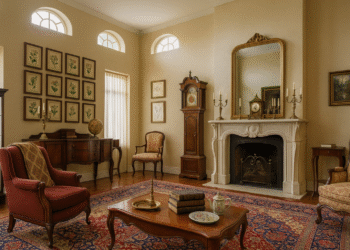
Use this museum demo to sharpen how you identify antique furniture by reading carving, tool marks, and period techniques. It pairs with our joinery tips and shows what authentic surface work actually looks like—helpful when separating hand work from later machine production and spotting restoration. Duncan Phyfe Low-Relief Carving: Bow Knot & Thunderbolt Crest — The Met
A characteristic feature of the Grecian-style chairs and sofas made in the Phyfe shop before 1820 is the low-relief carving in the scrolled crests depicting a variety of classical motifs. Included among these motifs are classical swags; sheaves of wheat and cornucopias, emblems of good fortune and plenty; Roman fasces, composed of a battle axe bound within a bundle of rods, a symbol of strength in unity; and clusters of thunderbolts tied in a bowknot, an attribute of the Greek god Zeus, whose vaunted eagle messenger is often depicted clutching one in his talons. This latter motif is found on scroll-back chairs and a sofa from the three documented sets made in the Phyfe shop for the wealthy New York merchant William Bayard (1761–1826) in 1807. three different hands at work in the low-relief carving on this seating furniture, which indicates that Phyfe either employed three carvers in his workshop or subcontracted the work to a specialty carving shop that employed several experienced carvers. The video shown here presents the three varieties of carving on the Bayard seating furniture, and also features a professional carver, Allan Breed, explicating the art and mystery of carving a low-relief bowknot and thunderbolt on a scrolled crest-rail panel. Related exhibition: Duncan Phyfe Master Cabinetmaker in New York December 20, 2011 — May 6, 2012 A Production of the Digital Media Department, MMA Produced and Directed by Christopher Noey Director of Photography: Wayne de la Roche Editor: Corinne Colgan Gaffer: Dave Hallas Sound Recording: Fred Burnham Production Assistant: Seth Uhlin Scholarly Consultant: Peter Kenny
Why this helps your ID skills
- See authentic period carving and tool control up close (great for distinguishing hand vs. machine work).
- Relate surface detail to construction and joinery, your fastest dating signals.
- Build a mental library of cues you can use at shows, shops, and previews.
Next, compare what you saw to our guides: Identify Antique Furniture: Styles & Joinery and Antiques Worth Money.